
Patients go to hospitals each day to seek treatment. But for thousands of these people, the hospital is where they’re injured, not due to their condition, but because they’ve fallen.
One patient attempts to get up in the middle of the night to go to the bathroom. A frail woman recovering from hip replacement falls over. A stroke survivor, disoriented and confused, moves too fast. In just a few moments, a minor incident becomes a medical crisis.
It occurs more frequently than you may think. Falls are the most common adverse events in hospitals. Until recently, hospitals and other care facilities have had few ways to prevent them. But these are now on the way out, thanks to AI.
AI fall detection technology combines computer vision, machine learning, wearable sensors, and predictive analytics to monitor patients around the clock. The technology can detect risk factors in the moment and notify people before a patient falls.
This guide covers everything, from the scale of the problem to how the technology works to what hospitals can do right now to get started.
How Big Is the Hospital Fall Problem?
The Numbers Are Alarming
According to research published in Frontiers in Digital Health, roughly 1 million patient falls happen in U.S. hospitals every single year. That results in around 250,000 injuries and up to 11,000 deaths annually.
About 2% of all hospitalized patients fall at least once during their stay. Of those falls:
- 25% result in some form of injury
- 10% are classified as serious, including fractures, head injuries, and internal bleeding
Some patient groups face a much higher risk. Stroke patients, for example, have a fall rate between 14% and 65% during hospitalization. And among adults aged 65 and older, one in four falls every year, with each fall making the next one 50% more likely.
What Does a Single Fall Actually Cost?
A single injurious fall adds over $35,365 in costs per patient, according to JAMA Health Forum. Looking at the bigger picture, the total cost of treating fall-related injuries in older adults is projected to exceed $101 billion by 2030.
Beyond the money, falls lead to:
- Longer hospital stays
- Higher risk of hospital-acquired infections
- Extra tests, surgeries, or rehabilitation
- Permanent loss of mobility, up to half of patients over 65 who fall and break a hip never fully recover
There’s also a legal side. The Centres for Medicare & Medicaid Services (CMS) classifies serious fall injuries as “never events”, meaning hospitals receive no extra reimbursement for treating them. The financial and reputational damage can be enormous.
Why Traditional Fall Prevention Isn’t Working
Hospitals have been trying to prevent falls for decades. Standard tools include the Morse Fall Scale, bed exit alarms, non-slip socks, and keeping high-risk patients near the nursing station. These methods have their place, but they come with real limitations.
Risk Scores Are Subjective
One nurse may rate a patient as high risk. Another might not. There’s no consistent standard across shifts, wards, or hospitals. That inconsistency costs patients.
A Single Assessment Doesn’t Tell the Whole Story
A patient’s fall risk changes throughout the day, based on medications, fatigue, hydration, and health status. A morning assessment tells you very little about what’s happening at midnight.
Most Tools React Instead of Predict
Bed alarms go off after a patient has already started getting up. By the time staff respond, it’s often too late. Physical restraints, once used as prevention, are now discouraged because they can cause agitation and sometimes increase fall risk.
Nurses Are Stretched Too Thin
Nursing shortages are a growing global crisis. Expecting already-stretched staff to maintain constant one-on-one monitoring of every at-risk patient isn’t realistic. Healthcare needs technology that extends what care teams can do.
How AI Fall Detection Technology Works
AI fall detection isn’t a single tool, it’s a combination of technologies working together. Here’s how each piece fits in.
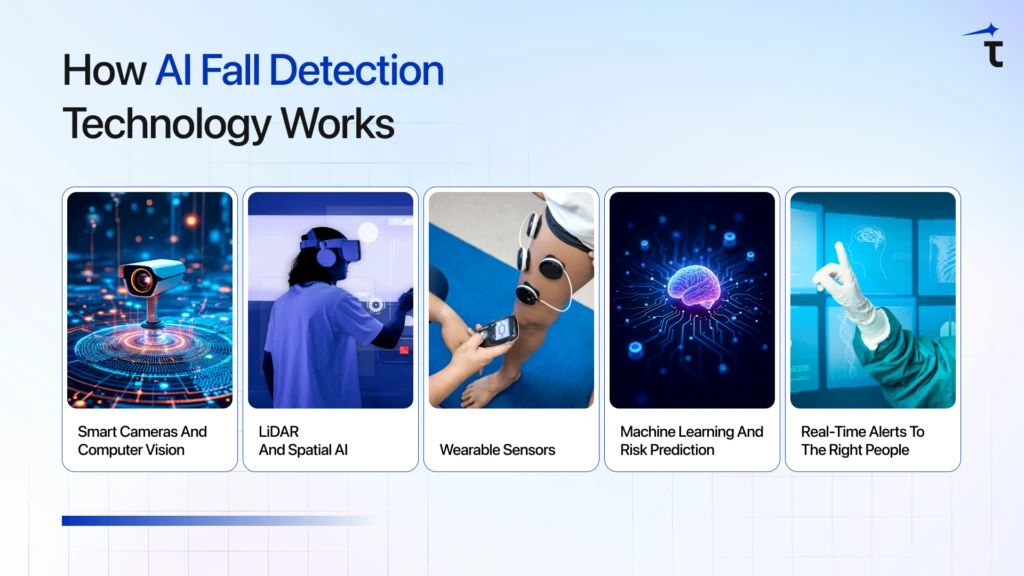
Smart Cameras and Computer Vision
AI-powered cameras in patient rooms track body position and movement in real time. These systems can:
- Detect unusual posture or body positioning
- Identify sudden movements that signal a fall
- Recognize when a patient is preparing to get up without support
Many systems protect privacy using blurred or anonymized images; the AI reads movement data without storing identifiable footage of patients.
LiDAR and Spatial AI
LiDAR (Light Detection and Ranging) uses infrared laser pulses to create a 3D map of a room. Unlike cameras, it captures no visual images at all, only movement and position data.
This makes it completely private while remaining highly accurate. Spatial AI using LiDAR can detect when a patient’s centre of gravity shifts, like leaning forward from a chair or swinging legs off a bed, and alert staff before anything goes wrong.
Wearable Sensors
Smart wristbands, pendants, and clip-on sensors track:
- Sudden changes in speed or direction
- Gait patterns and walking stability over time
- Early signs that fall risk is increasing
Wearables work well in settings where cameras aren’t practical or appropriate.
Machine Learning and Risk Prediction
This is where AI goes from detecting falls to preventing them entirely.
Machine learning models analyze each patient’s data, age, diagnosis, medications, mobility history, vital signs, and previous falls and generate a personalized risk score that updates in real time throughout the day.
These models are trained on millions of historical patient records, learning which combinations of factors predict a fall, often spotting patterns no human would catch. Staff see the scores on a live dashboard and can act before risk becomes reality.
Real-Time Alerts to the Right People
All this monitoring only works if the right person hears about it fast enough. Modern AI fall prevention systems connect directly with:
- Nurse call systems
- Staff smartphones via mobile apps
- Bedside alert panels
- Central monitoring stations
What the Research Actually Shows
The evidence for AI fall detection is solid and growing fast.
A comprehensive 2025 review in Safety Science found that AI-driven systems reduce hospital fall rates by 15% to 40%. Even the lower end of that range means tens of thousands of injuries prevented every year.
VirtuSense’s system has reportedly helped more than 1 million patients, prevented over 100,000 falls and saved healthcare facilities nearly $800 million.
It’s not all about the falls. AI monitoring eliminates the need for costly patient sitters, alleviates alarm fatigue (if correctly set up), and allows nurses to engage more with patients.